For years I disregarded Beck. When “Loser” came out, I thought “novelty song” and dismissed it outright. Still, despite my best efforts via various accidental means (similar to my deal with Everyone Loves Raymond I utterly dismiss it, yet somehow I’ve seen it), I ended up hearing bits and pieces of Mellow Gold and it didn’t change my mind (see aforementioned Everyone Loves Raymond reference). Then Odelay came out and even with a few strong singles, I remained nonplussed by the key-fob sized Mr. Hanson. Plus, the cover of that album really got to me after awhile. I mean yeah, it’s kind of funny but it just looks like it’s totally aware of being a weird/funny album cover. And that kind of overly conscious, cultivated oddity works me into a right lather. Like doofuses who think it’s cool to collect John Wayne Gacy's paintings.
So I sat on the sidelines and outright ignored Mutations at the time (at the urging of my boyfriend, I recently gave it a shot and it’s not bad). Sounds like reanimated Syd Barret and a non-sucking Bowie, with dusting of post-krautrock Eno and Nick Drake's gossamer whisper. Midnite Vultures was fine, but never made it to heavy rotation; I only just realized “Debra” was on it.
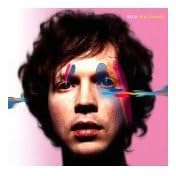
Signal Sea Change. I heard “Guess I’m Doing Fine” and I melted. Then I heard “Golden Age” and was an utter goner; it never occurred to me that it was Beck. I got the whole album and I’m not really sure what the tipping point was–music, words, time in my life–but for some reason it all washed over me in a gorgeous, honey-hued haze. After further listening, with the initial infatuation gone, I realized that all the tracks have a similar aural range and the lyrics, well, aren’t great. They remind me of Foo Fighters lyrics in the sense that there are intense fragments of insight, but also an internal monologue that we don’t hear and ultimately, the lyrics and vocals end up acting as another instrument. I mean, yes, there is the obvious theme of Beck’s long-term relationship ending but the music speaks far louder than the words. The same slow tempo mimics the static blur of heartache and the mourning period that follows it. Most ballad-inclined musicians don’t realize how difficult it is to play slow music smoothly and have it land right in the pocket so it ebbs and flows seamlessly. Impressively, Sea Change flows as a body of work and sustains, like a book.
One of the reasons I moved away from big cities and back to my medium-sized hometown was that I had lost sight of the sky. In big cities, you are able to catch glimpses of it, but not whole sheathes. I still marvel at the expanse of sky now – despite the fact I’m two years into sky sightings. I played Sea Change in my car to re-inspire myself for this piece. As I was driving down the highway to go food shopping, I realized this album is like watching the sky – a thick patina of blue, white and gold. The swath of big sky, like the sea, shows no endpoint, no horizon line. Kind of like heart-break – it rolls on and on. With Beck’s help (of all people!), I can see the sky, the endpoint and the beauty of the stars. Can hear 'em too.
Lisa Oliver is a Columbia-educated writer whose work has appeared in The Guardian, Stylus, The Fly UK, Musicweek UK, Yahoo! Music, NME, Publishers Weekly, Domino and People.
Blowjob, blowjob, blowjob. Okay, that’s out of the way.
No, wait – fuck, fuck, fuck.
Now we can discuss Liz Phair.
I’ve never been a Liz Phair fan. She’s one of those artists I like in theory (Pavement anyone?) but not in practice. I remember when Exile in Guyville came out and was touted as her reply to Exile on Main Street, which just sounds dumb. Then I actually heard the album, and it did indeed sound dumb – it’s the confused musing of a girl who doesn’t understand her vocal range and likes to get her tits out. However, I’m no stranger myself to being a confused girl who doesn’t understand her vocal range and likes to get her tits out. So occasionally I’d cut her some sisterhood slack and revisit. Its low-fi, vocal warbling just began to sound more and more dated as time went on. Plus, her pandering, whining, little-girl bullshit began to get on my tits. Or maybe it just hit too close to the tits for me. I double-dog dare anyone to find a strong-willed, self-confident woman who doesn’t silently long for a boyfriend to give her the stupid old shit like sodas and letters. I guess Liz (like the rest of us) had to learn the literal hard way that just because a boy fucks you, that doesn’t mean he really likes you. Still, you do have to admire someone who spreads one’s diary pages open as easily as spreading one’s legs open for the entire world to see.
I much prefer the Liz Phair of “Never Said,” a subtle yet wicked Liz Phair. She’s not quite the wordsmith she thinks she is but still…when she purrs that she’s clean as a whistle…that is the sound of thighs getting wet. But then she counters all the good clever stuff with her steadfast dedication to being photographed with her cupid’s bow lips parted, head tilted back, doing her best Alicia Silverstone impression pose. Got it Liz – you dig giving head. Now, can you either get your head down there or just move on please?
I’ll follow my own request and just get my head down into her eponymous 2003 affair – which paradoxically strikes me as a grown-up answer to the adolescent meditation of Exile. She should have called it Homecoming in Womantown.
Instead of begging to be some dude’s blowjob queen, she’s playing with his Xbox. She’s no longer just “6’1,” she’s “Extraordinary.” She doesn’t need some douche for a boyfriend; she’s using his jizz as her personal age-retardant. I don’t know who Liz is blowing, but I’ve never encountered “hot” cum. Sounds like a choking hazard.
Yes, some of the music is Matrix-rocker-confections, and her vocals are pro-tooled and pitch-perfected to airbrushed-centerfold perfection, but I don’t care. It sounds happy, full of life and spunk (all kinds of spunk) on “It’s Sweet” and “Why Can’t I?” She’s shed her lo-fi hair shirt, crystallizing into the true goddess she was destined to be. Its amazing how growing up can make someone so content with who they are. If selling out makes her this at ease, she should have done it years ago.
Is her answer to the male gaze the female just-open-enough-mouthed stare? No, I don’t think she is clever enough to be fully cognizant of and able to toy with academic feminism. However, her answer to herself is making the music she wants to make and men, women, and the music press can all go to hell. I raise both my glass and my rack to her. Lisa Oliver is a Columbia-educated writer whose work has appeared in The Guardian, Stylus, The Fly UK, Musicweek UK, Yahoo! Music, NME, Publishers Weekly, Domino and People.
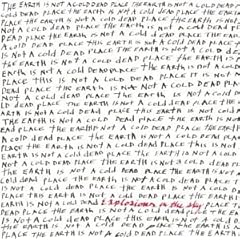
Explosions in the Sky - The Earth is Not a Cold Dead Place
Explosions in the Sky - The Earth is Not a Cold Dead Place by Lisa Oliver
“Post-rock” is about as descriptive a term as “walking upright.” And like “walking upright,” it’s occasionally far from accurate. Give “post-rock” a wide berth. In the same vein as “angular” or “meta,” “post-rock” serves a paradoxical purpose of inclusion and exclusion. Those in the know can smugly elevate status in their megalomaniac social hierarchy, feeling fine about not relating to the great unwashed masses that are blissfully unaware of the surrounding frowns.
Explosions in the Sky are for listening to when I’m engaged in something else: cleaning the den, snacking, having a phone conversation. It doesn’t require my full attention because it’s as captivating as a white tube sock with a hole in the toe. The hole’s there but I easily multitask beyond it as its nuisance level hums in the background. In fact, that’s a better way to describe it: EITS remind me of my neighbor’s air conditioner. I occasionally notice it, think I’d like one, then think of the expensive, then go back to cleaning, snacking, or whatever myriad bullshit task I’m doing.
Why not just call it what it is? Boring. Okay, it builds. But so does plaque and you don’t see indie folk getting all jacked up about that. Subtle but neither clever nor intricate, and it doesn’t require that much skill to just to pitch up and back down again. They stare at their instruments as if they’re faceting a diamond, but all that concentration is focused on is plunking an E string, and then re-plunking it to follow. If there are layers, it’s hard to tell; for a musical baklava, it lacks in buttery, nutty goodness.
At least Godspeed You! Black Emperor kicks out the jams muthafuckers and Mogwai belies the novelty of watching a foreign movie with no subtitles—you don’t know what’s going on, and it’s kind of pretentious, but you’ll ride along because it’s interesting. I’m not really a huge fan of either Mogwai or GY!BE, but I still hear engagement in what they’re doing.
“Hypnotic,” “elliptical,” and “delicate” are all common descriptors of this stuff, and with the right band I’m hardly an exception. But it takes a far more sophisticated aural palate than mine to use them in a complimentary way with these clowns. To really convey the sublime majesty of sustained frailty over repetition, you need to be really good at minimalism, autistic, or Brian Eno. Explosions in the Sky are none of these things. Explosions in the Sky are the instrumental version of the Ramones, riding their sound until the wheels fall off. Or until everyone forgets they put it on.
Lisa Oliver is a Columbia-educated writer whose work has appeared in The Guardian, Stylus, The Fly UK, Musicweek UK, Yahoo! Music, NME, Publishers Weekly, Domino and People.
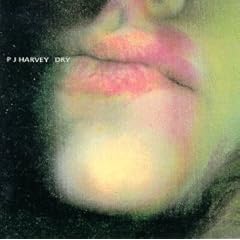
Dry makes me feel like a loser. And it’s confusing. Not confusing like physics (if you throw a Toyota Yaris and a Hummer off a high-rise–they’re going to hit the ground simultaneously?), but confusing because people who I think have great taste love Dry. When I say I don’t like it, they give me the old stink-eye-to-eye-roll-to-exhale-of -pitying-air routine. Their non-verbal condescension speaks volumes; It says, “You are a rock charlatan.” To my uncouth ears Dry sounds like a dog yelping for air in a poorly-ventilated hatchback. And that dog can’t play guitar.
Much of the press for Dry praised its ability to challenge female sexuality. This album’s challenges to female sexuality are on the same level as a female comedian joking that eating a whole cheesecake over a kitchen sink with her hands gives her more pleasure than a man can. So many of Harvey’s lyrics remind me of the film Carrie: first comes the blood, then the boys. Is sex dirty? Am I dirty for wanting sex? Does my over-articulated sexuality make my hips look big? Do men make me unclean? Can I move things with my mind? Blah blah blah. Just own your bull’s eye, Polly Jean, and stop the hand-wringing. De Palma should remake Carrie and insert Harvey performing “Happy and Bleeding” into the shower/period scene with Harvey becoming a human shield against all those tampons being chucked at poor Sissy Spacek. And Stephen King deserves royalties for “Sheela-Na-Gig” because Harvey gives him the “dirty pillows” shout-out. Although I do have to admit “Dress” and “Plants and Rags” are decent because they sound the most fully fleshed and crafted. Plus she sings, as opposed to throttling them.
I’ve developed a theory researched with small empirical data sets–hello, academic credibility–postulating that P.J. Harvey is popular because she’s sexual, plays guitar, and isn’t unattractive. My algorithm goes: female ≥ attractive (fuck + guitar) = gentlemanly ear pricking.
Harvey is often lumped into the 90s women-in-rock movement. Erm…no. She doesn’t fall into the scented candle, furrowed brow school of Sarah McLaughlin, the bruised Pagan dream-catchers of Tori Amos, or Ani DiFranco’s tomboys-wearing-tank-tops-and-Doc -Marten’s coterie. (I do dig this movement, but I’m not a fully-paid up member.) But Polly doesn’t care about being an empowered WO-MYN. Her frisson of perplexed vulnerability makes that clear. She’s a lithe live wire of neurosis; anxious conflagration blazes out of her sinewy tendons.
John Peel’s (one of her biggest champions) review of her first single pointed out that her work is “admirable if not always enjoyable” –a very fair assessment–despite the fact Peel’s rationale is not the same as mine. He finds her emotional geyser uncomfortable to listen to whereas I find it a cheap and easy shot at intimacy. I find the clumsy cacophony of plinked, plunked notes and novice smoke and mirror time signatures to be not enjoyable. Still, there are things to admire. Despite the sonic miasma efforts, I still hear the bones of blues and punk–and that’s admirable. Also admirable is the fact that Dry is genuine musical footprint. It’s like looking at someone’s baby picture when they’re grown–you can see where that matured adult face came from. You can still hear the nascent yowling and fat guitars in later work, but her skill set, along with her confidence and self-actualization, has bloomed. Finally, Dry is admirable, if not enjoyable because it begins to set in motion P.J. Harvey’s ability to purge her pussy issues for inspiration, as opposed to flagellation.
Lisa Oliver is a Columbia-educated writer whose work has appeared in The Guardian, Stylus, The Fly UK, Musicweek UK, Yahoo! Music, NME, Publishers Weekly, Domino and People.