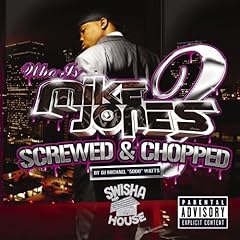
Mike Jones - Who is Mike Jones? (Screwed and Chopped by DJ Michael “5000” Watts)
Mike Jones - Who is Mike Jones? (Screwed and Chopped by DJ Michael “5000” Watts)
by Jonathan Bradley
Kingdom Come. Encore. Electric Circus. It’s no secret that good rappers can make bad albums. Talent on the mic has never been any insurance against dismal studio output. But just as true, though far less recognized, is the converse: Bad rappers can and do make good records. As rappers go, Mike Jones is one of the worst.
Jones, the loud, graceless Houston MC, is a terrible rapper. It is useless to even try to evaluate him by the standards of good rap, because he does not conform to them. How do you judge the wordplay of a rapper who has none? How do you consider the metaphors and imagery of a rapper who gives no indication that he understands what those words mean, let alone how to use them in his music? The kindest thing that could be said for Jones’ microphone talents is that he appears to be genuinely in love with rhyming. That is not to say that he shows admirable dedication to his craft, spending a lifetime fine-tuning his phrasing, poring over his verses and pouring creativity into the construction of his couplets. No, Mike Jones sounds like he never got over being fascinated by the simple fact that he can highlight the similar ending sounds of certain words by placing them in close proximity with each other. Even if the endings aren’t particularly similar. Even if the words in question are actually exactly the same word. Jones sounds like he’s having the time of his life hollering them out anyway.
When toward the end of 2004, major labels turned their attention to the thriving independent Houston hip-hop scene, the city possessed a wealth of talented artists of a variety of styles. From veterans like Scarface and UGK’s Bun-B to the thoughtful, introverted cousins Z-Ro and Trae; from the weed-whacked weirdo Devin the Dude to the easygoing, poppy Lil’ Flip and to mixtape maestros Lil’ Keke and Chamillionaire, Houston was a city brimming with talent. For the first time since the heyday of the Geto Boys, out-of-towners were paying attention. And yet somehow, whether through hustle, business acumen or pure good fortune, the task of introducing the legacy of Texas hip hop to the nation fell to Mike Jones.
Who?
Mike Jones.
And yet Jones didn’t stumble. He refused to allow megalomania or arrogance to derail his hometown’s opportunity. Quite the reverse: Who is Mike Jones? is a missive from a relatively humble ambassador for his local culture, one who was smart enough to let his more talented and more deserving peers grab the attention while he took a back seat. His album serves as a kind of companion piece to a prior, independently released Houston primer, the Swisha House mixtape Major Without a Major Deal (The Day Hell Broke Loose 2), which also featured him prominently.
The first single from Who is Mike Jones?, the song that first focused national attention on Houston, particularly Swisha House’s slice of Houston, was the stunning “Still Tippin’.” The track, a dark, crawling banger built on a mournful string figure and a slowed-down vocal sample — a technique that was, at the time, rare outside the city —had been floating around on mixtapes, including Major Without a Major Deal, for quite a while. It could be credited to any of the three rappers who contributed verses: Slim Thug, Mike Jones and Paul Wall. There was even an alternate version with a different beat and a verse from Chamillionaire.
That Jones, the least impressive rapper of this collection, ended up with the song as his first single could be attributed as underhanded opportunism on the rapper’s part, and perhaps it was. But it could just as easily have been the result of admirable selflessness. “Still Tippin’” gave national exposure to two superior rappers who outclassed Jones, as he must have known they would. Even with his inclusion of reasonably dexterous localisms like, “catch me lane switchin’ with the paint drippin’/turn your neck and your dame missin’/Me and Slim we ain’t trippin’/I’m finger flippin’ and syrup sippin’/Like Do or Die, I’m po’ pimpin’,” this was a Mike Jones track in name only. As far as its impact was concerned, and as far as many first time listeners were concerned, this was a single credited to the city of Houston.
And Who is Mike Jones? scaled this approach up to album length. Jones does all he can to disappear into the background and to act as, at best, master of ceremonies for his own city’s coming out party. It is as if he understood his limitations, and did all he could to offset them. He opens the album up to a number of local luminaries and these rappers, like Bun-B, Lil’ Keke and Killa Kyleon, all effortlessly put their host to shame. Jones’ most gracious move is the laid back highlight “Flossin’,” which sounds exactly like it might be a Big Moe solo track, even though Moe only sings the hook.
The production of the album is also fiercely local, with the few interloping beat makers (like Three 6 Mafia, responsible for the superb “Got It Sewed Up”) adjusting their sound to conform to the prevailing aesthetic. Where the far more talented Slim Thug sprinkled his major label debut with expensive Neptunes beats, Jones understood that the bizarre Houston sound was one of his best selling points, and there was little point diluting it with production that could have come from anywhere.
And with beats like the frenetic “Turning Lane,” or the sparse, reggae-tinged “Know What I’m Sayin’” Jones doesn’t need to say much of interest. While his rhymes may be entirely lacking in creativity, he can flow, and he never embarrasses himself with the kind of clumsiness Rick Ross is apt to exhibit. He shouts his lyrics with boyish enthusiasm, and his generally good-natured outlook makes him an easy rapper to listen to. When not dwelling on his favorite talking points — his name, his phone number, his staggering wealth — he sticks mostly to running through local cultural signifiers like candy paint, prescription cough syrup and screwed music. The album’s sense of place is so strong that you begin not to mind the over-excitable tour guide.
Even the few songs that do broach less standard themes succeed. “Scandalous Hoes” morphs from boilerplate misogyny into an account of distrust and rejection. Jones sounds genuinely hurt when he complains that women “don’t want me for me,” which taken with “Back Then,” in which he explains that the girls he liked had no interest in his chubby frame when he didn’t have any money, almost hints at a complexity you wouldn’t believe possible from a rapper who seems most interested in shouting his name and his phone number at you. And “Grandma,” Jones’ ode to his deceased grandmother doesn’t have much pathos, but it doesn’t have much bathos either. Jones doesn’t stop shouting for this elegy, but his uncomplicated approach works in his favor: he sounds like he wants nothing more out of the track then to tell you how awesome he thought his Grandma was.
(Incidentally, Jones’ Grandma is a great minor character on this record. She appears to be part mentor and part consigliore for Jones, a role that has her advising him on how best to market his record in strip clubs, and warning him to be wary of unscrupulous women.)
The original Who is Mike Jones? is a fine album, but in proper H-Town fashion, it is best appreciated in its chopped and screwed form. On its original release, the album came packaged with this slowed down edition as a bonus disc; the remixed version can still be purchased separately.
The chopped and screwed technique offers DJs a place in contemporary hip hop other than curator (DJ Drama, DJ Khaled) or niche-audience technical wizard (DJ Shadow). Michael Watts approaches his remix of Who is Mike Jones? like he’s performing a set, and the album follows a natural progression. He drops elements from tracks into others, creating an uninterrupted listening experience, and subtly reorders songs to improve their flow. Mike Jones’ verse in “Still Tippin’,” for instance, is moved to the end of the track, meaning the repeated lines “Back then hoes didn’t want me/Now I’m hot they all on me,” blend seamlessly into “Back Then,” which samples that lyric as its hook. Likewise, he introduces the syncopated melody line from “Screw Dat” halfway into the previous track, and, after the track begins, augments it subtly with the sampled yodeling from “Cuttin’.” Watts’ scratching and chopping is not flashy but it is effective, and adds to the disorienting ambience already induced by the pitched-down music. Jones voice becomes a dragged out bellow, just one more sonic element in this mix, and his fondness for repetition coalesces with the favored screw technique of repeating phrases. The individual tracks cease to have rigid structure and dissolve into an uninterrupted volley of beats and flow, perfect for long, slow drives down packed freeways in the hot sun.
Mike Jones has had a tough time getting his follow-up album released, despite a few likable singles (“Mr. Jones,” “My 64”) that were apparently not liked by enough people. There’s every possibility that Who is Mike Jones? could end up being his only major label release, and it may even be better for his legacy if it is. On mixtapes leading up to Who is Mike Jones? release, Jones shouted gleefully that this album would be arriving in stores shortly; these lines remain preserved on the album that actually hit stores. His whole career seemed designed to lead up to this release, and when he did release it, he helped elevate his entire community. Texas rap’s star isn’t shining quite as bright as it did in 2005, but the city is now considered a major hip hop center, a status it decidedly lacked before Who is Mike Jones? hit stores. If, in the future, Jones slips into obscurity, and “Who is Mike Jones?” become a question few are able to answer, his album will still have done its work.
Jonathan Bradley has written for Stylus Magazine, Lost at Sea, Volume Magazine and the Western Front, and rules over his own miniature Internet fiefdom, the Screw Rock 'n' Roll blog. Although it's not widely known, he is Australia's best music critic.
by Jonathan Bradley
Kingdom Come. Encore. Electric Circus. It’s no secret that good rappers can make bad albums. Talent on the mic has never been any insurance against dismal studio output. But just as true, though far less recognized, is the converse: Bad rappers can and do make good records. As rappers go, Mike Jones is one of the worst.
Jones, the loud, graceless Houston MC, is a terrible rapper. It is useless to even try to evaluate him by the standards of good rap, because he does not conform to them. How do you judge the wordplay of a rapper who has none? How do you consider the metaphors and imagery of a rapper who gives no indication that he understands what those words mean, let alone how to use them in his music? The kindest thing that could be said for Jones’ microphone talents is that he appears to be genuinely in love with rhyming. That is not to say that he shows admirable dedication to his craft, spending a lifetime fine-tuning his phrasing, poring over his verses and pouring creativity into the construction of his couplets. No, Mike Jones sounds like he never got over being fascinated by the simple fact that he can highlight the similar ending sounds of certain words by placing them in close proximity with each other. Even if the endings aren’t particularly similar. Even if the words in question are actually exactly the same word. Jones sounds like he’s having the time of his life hollering them out anyway.
When toward the end of 2004, major labels turned their attention to the thriving independent Houston hip-hop scene, the city possessed a wealth of talented artists of a variety of styles. From veterans like Scarface and UGK’s Bun-B to the thoughtful, introverted cousins Z-Ro and Trae; from the weed-whacked weirdo Devin the Dude to the easygoing, poppy Lil’ Flip and to mixtape maestros Lil’ Keke and Chamillionaire, Houston was a city brimming with talent. For the first time since the heyday of the Geto Boys, out-of-towners were paying attention. And yet somehow, whether through hustle, business acumen or pure good fortune, the task of introducing the legacy of Texas hip hop to the nation fell to Mike Jones.
Who?
Mike Jones.
And yet Jones didn’t stumble. He refused to allow megalomania or arrogance to derail his hometown’s opportunity. Quite the reverse: Who is Mike Jones? is a missive from a relatively humble ambassador for his local culture, one who was smart enough to let his more talented and more deserving peers grab the attention while he took a back seat. His album serves as a kind of companion piece to a prior, independently released Houston primer, the Swisha House mixtape Major Without a Major Deal (The Day Hell Broke Loose 2), which also featured him prominently.
The first single from Who is Mike Jones?, the song that first focused national attention on Houston, particularly Swisha House’s slice of Houston, was the stunning “Still Tippin’.” The track, a dark, crawling banger built on a mournful string figure and a slowed-down vocal sample — a technique that was, at the time, rare outside the city —had been floating around on mixtapes, including Major Without a Major Deal, for quite a while. It could be credited to any of the three rappers who contributed verses: Slim Thug, Mike Jones and Paul Wall. There was even an alternate version with a different beat and a verse from Chamillionaire.
That Jones, the least impressive rapper of this collection, ended up with the song as his first single could be attributed as underhanded opportunism on the rapper’s part, and perhaps it was. But it could just as easily have been the result of admirable selflessness. “Still Tippin’” gave national exposure to two superior rappers who outclassed Jones, as he must have known they would. Even with his inclusion of reasonably dexterous localisms like, “catch me lane switchin’ with the paint drippin’/turn your neck and your dame missin’/Me and Slim we ain’t trippin’/I’m finger flippin’ and syrup sippin’/Like Do or Die, I’m po’ pimpin’,” this was a Mike Jones track in name only. As far as its impact was concerned, and as far as many first time listeners were concerned, this was a single credited to the city of Houston.
And Who is Mike Jones? scaled this approach up to album length. Jones does all he can to disappear into the background and to act as, at best, master of ceremonies for his own city’s coming out party. It is as if he understood his limitations, and did all he could to offset them. He opens the album up to a number of local luminaries and these rappers, like Bun-B, Lil’ Keke and Killa Kyleon, all effortlessly put their host to shame. Jones’ most gracious move is the laid back highlight “Flossin’,” which sounds exactly like it might be a Big Moe solo track, even though Moe only sings the hook.
The production of the album is also fiercely local, with the few interloping beat makers (like Three 6 Mafia, responsible for the superb “Got It Sewed Up”) adjusting their sound to conform to the prevailing aesthetic. Where the far more talented Slim Thug sprinkled his major label debut with expensive Neptunes beats, Jones understood that the bizarre Houston sound was one of his best selling points, and there was little point diluting it with production that could have come from anywhere.
And with beats like the frenetic “Turning Lane,” or the sparse, reggae-tinged “Know What I’m Sayin’” Jones doesn’t need to say much of interest. While his rhymes may be entirely lacking in creativity, he can flow, and he never embarrasses himself with the kind of clumsiness Rick Ross is apt to exhibit. He shouts his lyrics with boyish enthusiasm, and his generally good-natured outlook makes him an easy rapper to listen to. When not dwelling on his favorite talking points — his name, his phone number, his staggering wealth — he sticks mostly to running through local cultural signifiers like candy paint, prescription cough syrup and screwed music. The album’s sense of place is so strong that you begin not to mind the over-excitable tour guide.
Even the few songs that do broach less standard themes succeed. “Scandalous Hoes” morphs from boilerplate misogyny into an account of distrust and rejection. Jones sounds genuinely hurt when he complains that women “don’t want me for me,” which taken with “Back Then,” in which he explains that the girls he liked had no interest in his chubby frame when he didn’t have any money, almost hints at a complexity you wouldn’t believe possible from a rapper who seems most interested in shouting his name and his phone number at you. And “Grandma,” Jones’ ode to his deceased grandmother doesn’t have much pathos, but it doesn’t have much bathos either. Jones doesn’t stop shouting for this elegy, but his uncomplicated approach works in his favor: he sounds like he wants nothing more out of the track then to tell you how awesome he thought his Grandma was.
(Incidentally, Jones’ Grandma is a great minor character on this record. She appears to be part mentor and part consigliore for Jones, a role that has her advising him on how best to market his record in strip clubs, and warning him to be wary of unscrupulous women.)
The original Who is Mike Jones? is a fine album, but in proper H-Town fashion, it is best appreciated in its chopped and screwed form. On its original release, the album came packaged with this slowed down edition as a bonus disc; the remixed version can still be purchased separately.
The chopped and screwed technique offers DJs a place in contemporary hip hop other than curator (DJ Drama, DJ Khaled) or niche-audience technical wizard (DJ Shadow). Michael Watts approaches his remix of Who is Mike Jones? like he’s performing a set, and the album follows a natural progression. He drops elements from tracks into others, creating an uninterrupted listening experience, and subtly reorders songs to improve their flow. Mike Jones’ verse in “Still Tippin’,” for instance, is moved to the end of the track, meaning the repeated lines “Back then hoes didn’t want me/Now I’m hot they all on me,” blend seamlessly into “Back Then,” which samples that lyric as its hook. Likewise, he introduces the syncopated melody line from “Screw Dat” halfway into the previous track, and, after the track begins, augments it subtly with the sampled yodeling from “Cuttin’.” Watts’ scratching and chopping is not flashy but it is effective, and adds to the disorienting ambience already induced by the pitched-down music. Jones voice becomes a dragged out bellow, just one more sonic element in this mix, and his fondness for repetition coalesces with the favored screw technique of repeating phrases. The individual tracks cease to have rigid structure and dissolve into an uninterrupted volley of beats and flow, perfect for long, slow drives down packed freeways in the hot sun.
Mike Jones has had a tough time getting his follow-up album released, despite a few likable singles (“Mr. Jones,” “My 64”) that were apparently not liked by enough people. There’s every possibility that Who is Mike Jones? could end up being his only major label release, and it may even be better for his legacy if it is. On mixtapes leading up to Who is Mike Jones? release, Jones shouted gleefully that this album would be arriving in stores shortly; these lines remain preserved on the album that actually hit stores. His whole career seemed designed to lead up to this release, and when he did release it, he helped elevate his entire community. Texas rap’s star isn’t shining quite as bright as it did in 2005, but the city is now considered a major hip hop center, a status it decidedly lacked before Who is Mike Jones? hit stores. If, in the future, Jones slips into obscurity, and “Who is Mike Jones?” become a question few are able to answer, his album will still have done its work.
Jonathan Bradley has written for Stylus Magazine, Lost at Sea, Volume Magazine and the Western Front, and rules over his own miniature Internet fiefdom, the Screw Rock 'n' Roll blog. Although it's not widely known, he is Australia's best music critic.
Labels: Jonathan Bradley
posted by kiss out the jams at
4:44 AM
0 Comments